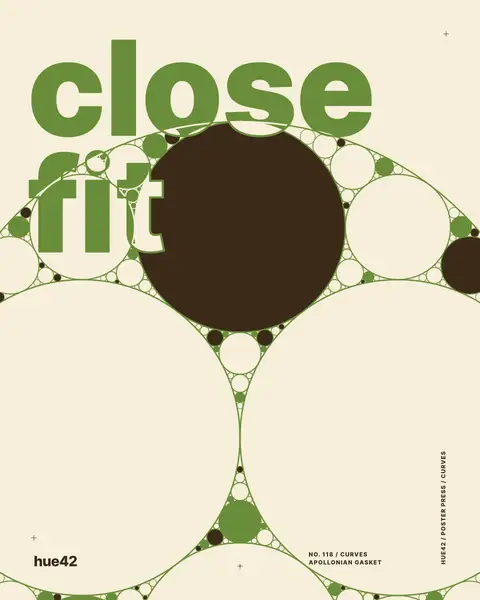
The Hilbert curve, described by the mathematician David Hilbert in 1891, is a single line that visits every cell of a square grid once, turning only at right angles and never crossing itself. Each quarter of the grid holds a smaller copy of the whole route. Here the first quarter of the journey is drawn about three times as heavy as the rest, so one corner of the maze stands forward. The grid is wider than a tall sheet and runs off its edge. Lettering sits in a cleared space in the top corner.
- What you can change
The words and the colors
The lettering shown is a placeholder. Everything here is set in the editor.
- TitleUp to 3 words of 10 letters
- Second lineUp to 44 characters: a date, a place, a name
- ColorsUp to 5 of your own, and which one is the paper
- ShapeSquare, Portrait, Story
- Title placementTitle above, Title below, Side title, Framed, Full bleed, Off the edge, No title
- Typeface30 faces, 1 of them free; shown in Space Mono
The drawing's own settings
- Order3 to 6, shown at 5
- Corner cut0% to 100%, shown at 0%
- Line weight0.6 to 8.0, shown at 3.0
- Zoomx0.6 to x1.8, shown at x1.0
- Turn-180° to 180°, shown at 0°
- Shown in
- #F7EDE2
- #5B3A4A
- #E8B4A0
- #C9963B
- Collection
- Curves, 14 posters
- Style
- mathematical art, line art, grid, geometric, fractal, maze